
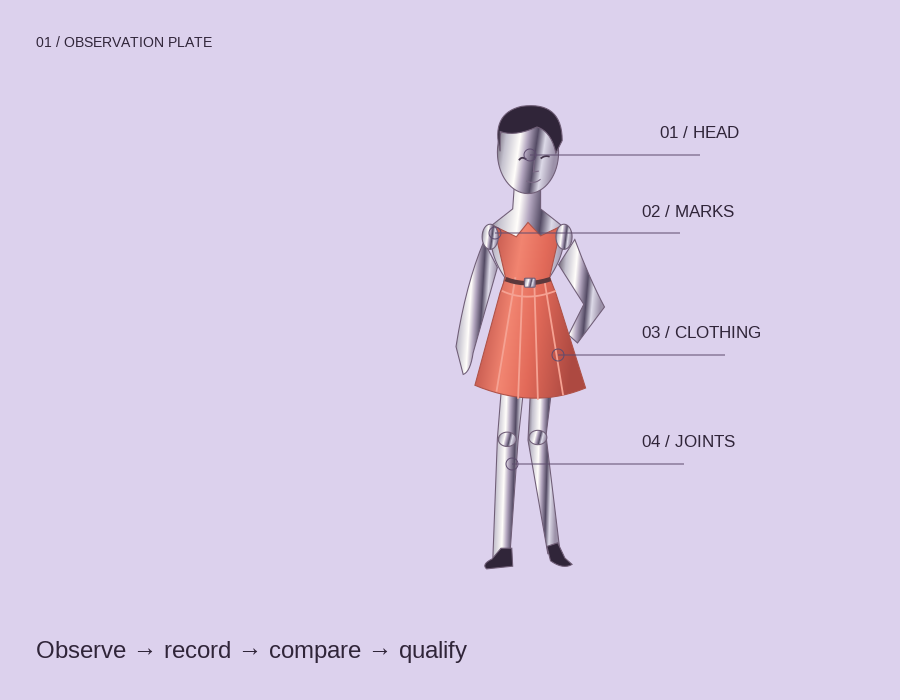
A good identification starts with a description another person could check. Give the doll a temporary record name, photograph what you can see, and leave the edition open until the evidence connects.
Make a first-pass record
Start with a neutral label such as “Doll A — blue dress.” Record the date you examined it, where it came from, and which parts arrived together. A seller’s title belongs in a field called “seller description,” not automatically in the confirmed model field. That small distinction keeps a useful lead from becoming an unsupported fact.
Photograph the front, back, both profiles, hands and feet. Add close-ups of marks, seams, closures and labels without forcing a joint or removing a fragile item. Keep the uncropped photographs as well as the detail crops. A tight crop can hide the part of the object that tells you what you are looking at.
Transcribe marks before interpreting them
Write down the characters exactly, preserving line breaks and symbols. Use a question mark for a character you cannot read. Record the location of each inscription: a head mark, a torso mark and a clothing label are observations from different parts. Do not combine them into an invented single product code.
A date can describe a design, a product release, a source publication or your own examination. Keep those meanings separate. In a concrete example, Mattel’s N4974 product record describes a 2009 release reproducing a 1959 doll. A historical year mentioned in the description does not turn the later product into an original.
Build a comparison you can explain
Choose a reference that identifies the edition explicitly. Copy its URL and title, record when you consulted it, and note the exact feature that agrees with your object. Then make a second list of differences and features you could not inspect. Search for counter-evidence as deliberately as you search for a match.
“The source names this edition and shows this feature. My object shares the feature, but the packaging is missing, so the edition remains a candidate.” This is an example of a recording method, not a claim about an actual doll.
Do not treat a resemblance in one photograph as an authentication. A doll, dress and box may need separate identifications. If a source identifies only a character or brand, stop at that level. An unresolved record is more useful than a precise answer with no support.
Finish with a question someone can answer
List the smallest missing piece of evidence: a legible mark, a named catalogue page, a package code or a photograph of the reverse. Record who supplied any later information and preserve the earlier version of your note. The collector’s worksheet gives you a place to keep observations, proposed identity and remaining questions separately.
Sources & scope
Source facts and our suggested recording methods are distinguished in the text. Sources consulted 27 September 2026; source publication dates, where available, are shown below.
- Mattel Consumer Support — The Original Teenage Fashion Model Barbie Doll — N4974 ↗Source publication date not stated. Consulted 27 September 2026.