
A reproduction can be a well-documented collecting object in its own right. The useful question is which edition you have and which source supports that answer.
Read two dates without collapsing them
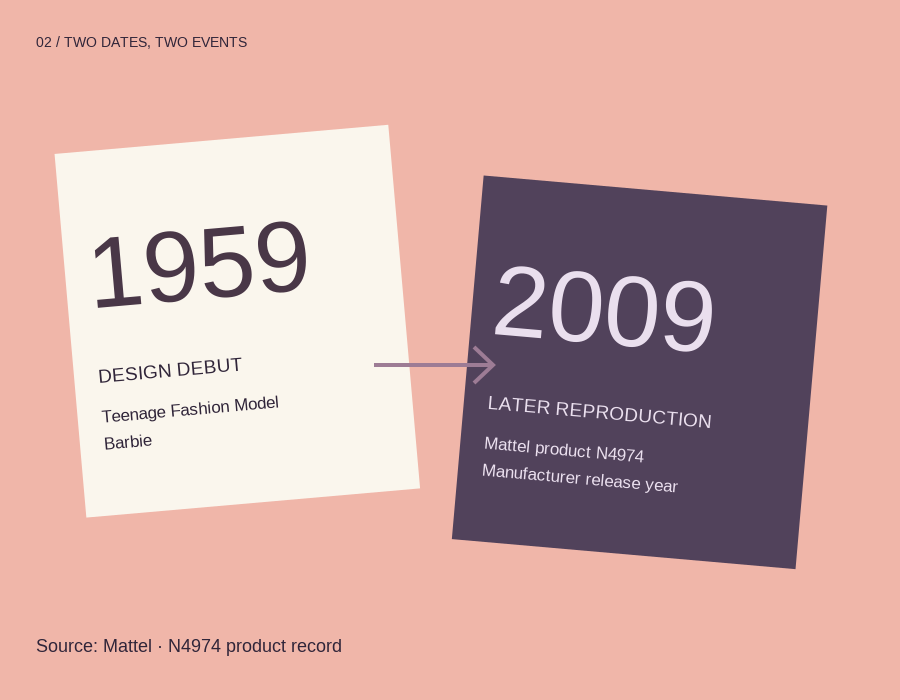
Mattel places Barbie’s debut in 1959. Its support page for The Original Teenage Fashion Model Barbie, N4974, lists a release year of 2009 and describes a reproduction. Those dates describe different events. The original design belongs to one historical moment; the later product belongs to another.
The N4974 description also refers to a reproduction of a 1960 fashion. A single box description can therefore contain several meaningful years. Write down what each year refers to before using any of them to label the whole set.
Use three columns in your notes
| Observed on your object | Stated by the source | Still unresolved |
|---|---|---|
| A legible package code | The manufacturer’s record for that code | Whether the doll and box originally belonged together |
| An outfit currently present | A named package contents list | Whether every piece matches that list |
| A visible date or inscription | The source’s explanation of the date | What the inscription means for this exact item |
The method prevents a common reasoning error: using an accurate fact from the source to answer a different question about the object. A product page can establish what a manufacturer offered; it cannot, by itself, establish what a particular seller has placed in a box.
Choose language that matches the evidence
“Manufacturer-described reproduction” is appropriate when the named record says so. “Looks vintage” describes an impression. “Original to this set” requires evidence linking components, not just evidence that each component exists. Keep those statements apart in collection notes and any later description you share.
If you have the doll but no packaging, describe the missing link. If a seller provides a catalogue photograph, ask which part of the identification it supports. Preserve the full page context, caption and source details in your private record so you can revisit the comparison later.
Collect the object you actually want
Decide whether your aim is a particular historical edition, a documented reproduction, a display look or a complete package. That is a personal collecting choice. Write the goal before comparing candidates so that an attractive image does not silently change your criteria. This guide provides a documentation method; it provides no rarity ranking, price estimate or investment forecast.
Sources & scope
Source facts and our suggested recording methods are distinguished in the text. Sources consulted 27 September 2026; source publication dates, where available, are shown below.
- Mattel Consumer Support — The Original Teenage Fashion Model Barbie Doll — N4974 ↗Source publication date not stated. Consulted 27 September 2026.
- Mattel Creations — The 65th Barbie Anniversary: Inspiration Through the Decades ↗Source date: 2024-05-13. Consulted 27 September 2026.