
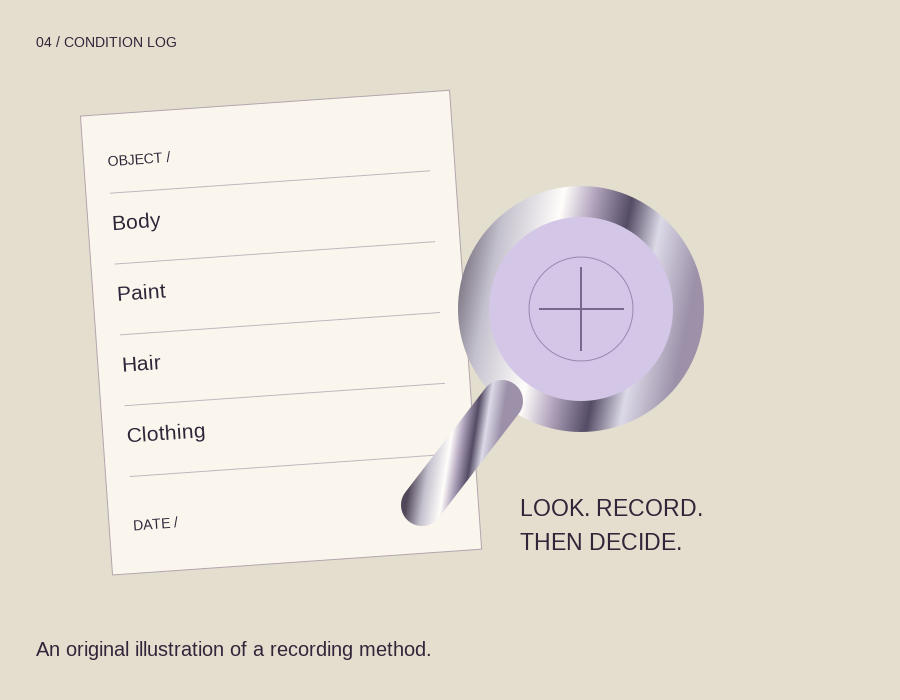
Condition notes are useful before any treatment. An untouched observation gives you a baseline; an undocumented intervention can make the next question harder to answer.
Begin with what you can observe
Under ordinary, indirect light, describe visible changes without naming a cause you have not established. “Yellow patch on the left forearm” is an observation. A diagnosis about the material or a previous treatment requires more evidence. Photograph the whole object and the affected area with the date and consistent framing.
The Canadian Conservation Institute describes several possible changes in ageing plastics and rubbers, including brittleness, cracking, stickiness and colour change. It stresses that the exact composition of an object can be difficult to establish. A photograph alone is therefore not a reliable material diagnosis.
Pause when the material is uncertain
CCI advises avoiding aqueous and organic solvents for these materials, warns against heat and damaging light, and recommends professional help for difficult cleaning and repairs. Its guidance applies to collections broadly; it is not a treatment recipe for your exact doll, hair fibre, paint or textile.
If a surface is sticky, cracking or shedding, record what you see and seek a qualified conservator’s assessment before attempting a cleaning technique. Do not turn an online before-and-after image into evidence that the treatment suits your object.
Build a condition log that can show change
Use a repeatable set of views and retain the original files. Note the display position and any recent change in location. If you notice a change, record it separately rather than silently replacing the earlier description. An honest log can include “not examined” for concealed areas.
Divide the record into parts: body, hair, face paint, joints, clothing and accessories. Avoid one overall adjective such as “excellent” when a short part-by-part description would tell a future reader much more. Mark any repairs you know about and distinguish your own observation from a previous owner’s account.
Prepare a useful specialist enquiry
Gather the object’s approximate dimensions, the marks you can safely read, photographs, provenance, known treatments and the specific change that concerns you. Describe what you hope to achieve: stable storage, safer display or an assessment before handling. Do not add a material name just to make the enquiry look complete.
When advice or work is received, record who provided it, when, what it covered and what remains unknown. Keep that record with the object. The purpose of this guide is documentation and careful escalation; no treatment has been tested on a doll for this website.
Sources & scope
Source facts and our suggested recording methods are distinguished in the text. Sources consulted 27 September 2026; source publication dates, where available, are shown below.
- Canadian Conservation Institute — Care of Objects Made from Rubber and Plastic — Notes 15/1 ↗Source publication date not stated. Consulted 27 September 2026.